Second Cycle: Recruiting 25/26
March 20, 2026 · 11 min read
About a bit more than a year ago, I had my first big boy internship interview. I remember making it to the final round and thought I had it absolutely in the bag. I waited one week, then another, and then another. 3 months passed and I also got my first rejection. Since then, I've tested and tried some techniques (shoutout to my various mentors) on how to better help me in this abysmal job market and I'll be sharing a bit of what I learned here.
For context, this recruiting cycle, I had one software engineering internship at a mid-sized company that isn't particularly famous for their engineering department but definitely well-known. If you want to see how I landed my first internship, check out my first recruiting cycle here.
Additionally, I was also "voluntold" by my student club, UBC BizTech to hold a career workshop that was a precursor to our flagship event, BluePrint, so most of the content and material, I'll reuse from those slides – memoization!
Why should you listen to me?
First of all some credibility stats so people don't think I'm rambling randomly:
- I've talked to a lot of people –mainly upper years and new grads that experienced the recent job market first hand post COVID.
- I've also tried a lot of different things, some worked, some didn't.
- Not to toot my own horn but probably my biggest flex; I've made it to the final round at every company I have interviewed at.
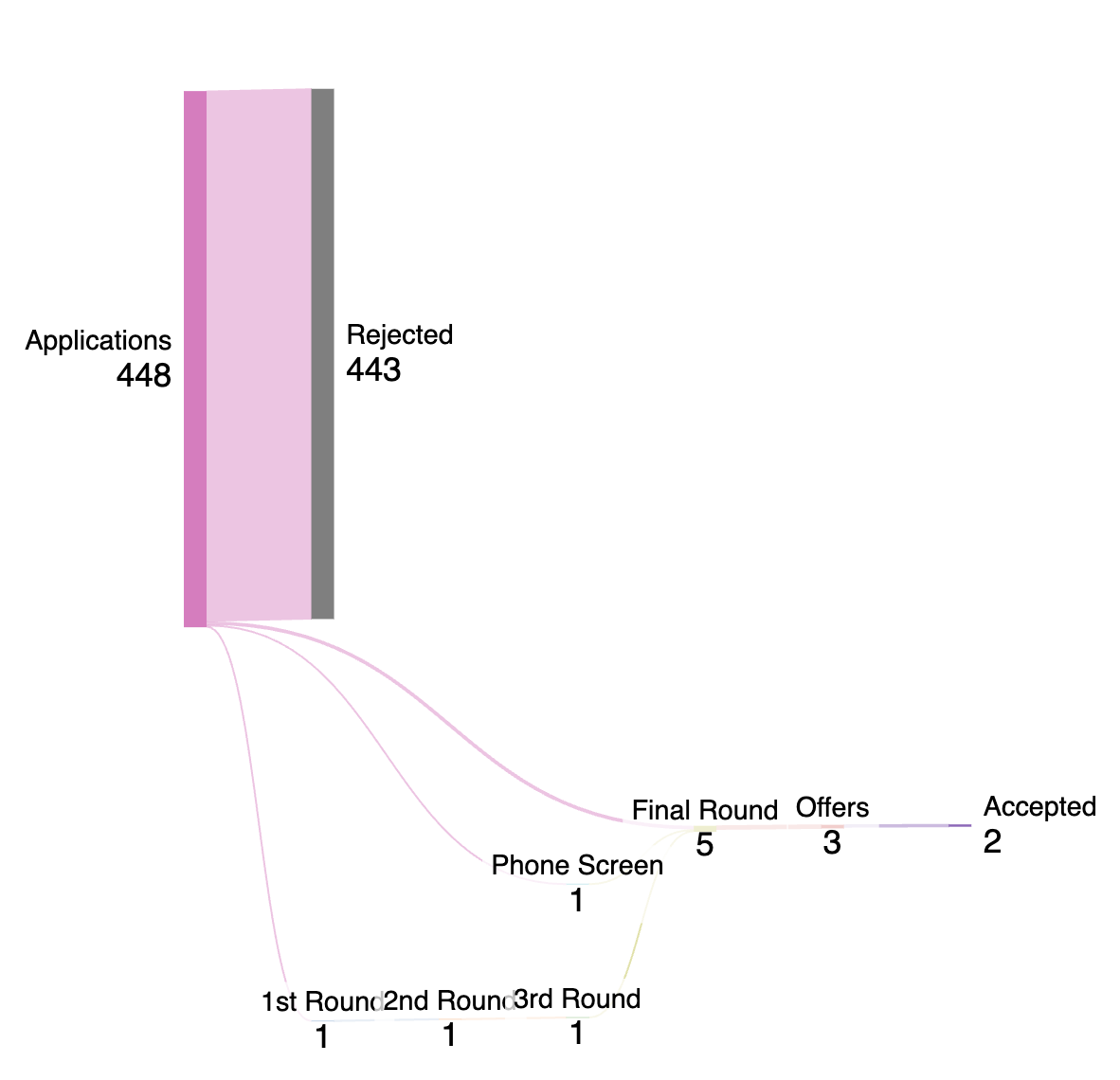
Below are some stats comparing my first recruiting cycle to my second.
1st Recruiting Cycle ~450 apps
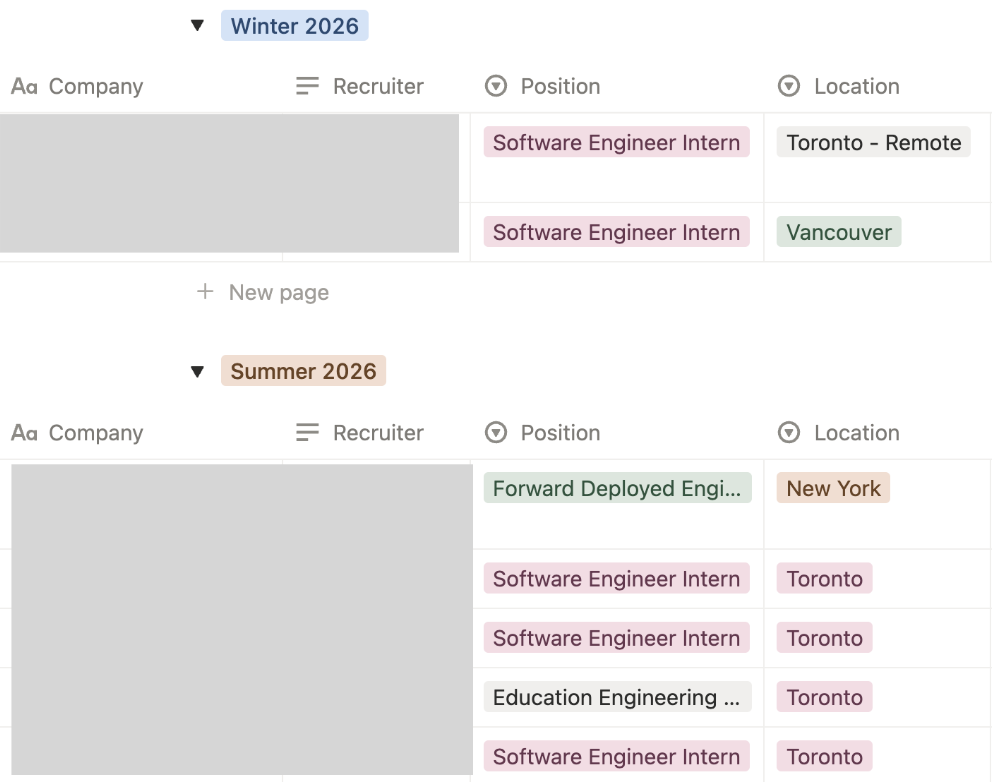
2nd Recruiting Cycle ~150 apps
Now I do want to emphasize that me making it to the final round != me getting all the offers. It would be amazing if that happened, but fumbles happen and they happen a lot.
Furthermore, what I'm going to say works for me, take it with a grain of salt. I've seen people with different workstyles/personalities succeed differently. For example, my sister who studies Biology and CS may not find it enjoyable to apply to every Big Tech company out there and instead would much rather focus on biotech companies, etc. In that industry, research + cover letters will be more helpful for her.
If you're anything like me though, I'd recommend you to pay attention.
Questions to ask
I remember when I first came into university not having written a single line of code in my life. I had a lot of questions so I'll give you the short answers to them all right now. I also highly suggest you go through them in order (there's a proper timeline)!
Is tech or software engineering right for me? (and other related questions)
Q: Isn't the job market "cooked"? A: Yes, but the advice all my mentors told me were that if you truly like software engineering, you will be employed (naive but also somewhat true IMO).
Q: Isn't software engineering becoming obsolete since AI is so prominent? What's the point of learning how to code? A: I believe if anything, it only makes it more important to learn how to code. Most software engineers I talked to was not worried because the sheer skill required to a) understand the code/debug, and b) make decisions based on tradeoffs are things that AI is not fully capably of doing. We need to people to make the AI anyways.
Q: Am I even smart enough to compete with people that have coded their entire lives? A: Yes. Yes you are. Software engineering is the most meritocratic profession in the world, you will become a good engineer if you try hard.
What do I do to become good?
Q: How do I start? A: Find a mentor. I highly recommend at least 2. 1 upper year ideally 1-2 years older than you. They will help you with interviewing, job hunt, resume, and potentially connecting with recruiters. The other will be in the industry. They will help you with grander scopes of your software engineering journey and high level questions. In terms of how many, the more the better but make sure you're able to keep relatively good contact with them.
Q: How do I code? A: Do an online course. YouTube videos, Udemy and Coursera are extremely cheap relative to tuition and courses often have flash sale. This is one I bought and did for $15. Also if you're a student, abuse that and join as a web developer for some club.
Q: How to build a good resume? A: First, use Jake's resume for formatting. Next get it reviewed a lot people, and update it constantly with new experiences/projects when you get/finish them. My resume probably went through 20 iterations during a recruiting cycle. Also reverse engineer your resume. Find out what skills you want to have (based on looking at job descriptions) and start building projects that have/use those.
Underrated meta tactics
- Cold emailing. Use Apollo.io to scout recruiters and automate emails (not an ad, their product is just very good and helped me get employed)
- Doing hackathons. High-profile companies will sponsor prizes. Looks great on resume if you win and makes fantastic behavioural responses (e.g. tell me about a time when you learned something quickly, tell me about a time when you disagreed with a team member, tell me about a problem you had to solve)
- Do mock interviews. Your future self will thank you. Do it with your friends, do it with yourself, the more you do the better. Focus on explaining, if your friends can't understand you, your interviewer won't either.
Anyways, I could talk more about the strategies I used but it would be endless.
STAT LINES
Here are all the companies I interviewed for Winter 2026 and Summer 2026. For some context, I did not email any companies this recruiting cycle and only relied on referrals and cold applying.
Software Engineer Intern, Super.com - Winter 2026
Started with an OA on Coderbyte with multiple different aspects including algorithms, trivia and regular coding. There was an embedded search terminal for you to search for syntax and functions. After passing there was a final round of OOP for an hour that had 4 parts. I only solved up to the 2nd part but focused a lot on explaining my thought process and code.
I ended up passing but did not get the offer. Assumed they had better candidates that potentially made it farther in the interview.
Remote, $30 CAD/hour, 4 months, had in-person options if you were in Toronto. Product is similar to Hotel Travago. I actually really wanted this since it had insane benefit packages and their remote/async-first policy was very interesting.
Software Engineer Intern, TELUS - Winter 2026
Given a referral by a previous intern. Straight to phone and then forwarded to a hiring manager for another screen. Final round was an hour consisting of trivia, algorithms and behavioural. Interview experience wasn't the best since it felt like at times they were asking questions just for the sake of asking questions (one of the questions was, what was the most complicated algorithm you know lol).
I received the offer and tried to negotiate to 4 months due to accepting another offer in the summer prior to it. Unfortunately, the position required 8 months and so I declined.
Hybrid in Vancouver/remote (both work), $27 CAD/hour, 8 months. The team I interviewed for was Billings and Collections team. Pretty cool product tbh since they worked with a lot of Google Cloud Platforms and benefits were quite nice.
Forward Deployed Engineer Intern, Palantir - Summer 2026
Again, given a referral by a previous intern. Straight to phone, then technical, onsite and hiring manager. Phone requires you to know the difference between FDE and SWE and why you are fit for your specific stream. Know yourself well (previous background/experiences on resume). Technical was standard algorithms, I didn't fully finish coding it but passed due to explaining my code well (I think)? Onsite was decomposition (which was systems design) and learning (given a framework/new stuff, how are you going to solve a problem with it). For onsite and FDE role specifically, always think in terms of the "client/user flow." I remember repeating "as a user, what would I want" several times and I believe that is the correct intuition, it also helps you get unstuck on what you need to do next. Learning is relatively straightforward, not much you can prepare for, maybe review syntax on Python/TypeScript. Hiring manager is tough, I didn't pass so I can't give much advice on it.
In-person in New York, $68 USD/hour, 4 months with $10,000 housing stipend. Crazy fumble in the hiring manager round. FDE at Palantir is where an engineer is "deployed" to a client site and works very closely with the client to help integrate their data into Palantir's ontology. Since I'm a Canadian citizen, I was in the commercial pipeline.
Software Engineer Intern, RBC Amplify - Summer 2026
OA into virtual onsite. OA was classic CodeSignal. I had a previous 548 that I could use but I wanted a 600 and despite attempting it again I did not score the prettiest. Somehow still got the interview for superday. Superday consisted of group interview which included a pitch + situational question with the other candidates, algorithmic question and systems design question. The systems design is super simple, basically as long as you know how a simple system works (database, load balancer and caching are like the deepest it'll go). Cool program and offer came super early. Accepted and committed.
In-person in Toronto, $32 CAD/hour, 4 months with $1000 sign-on bonus and $1000 relocation bonus. Amplify is much more different than your regular SWE internship (even moreso than the regular RBC internships). The best way to describe it is similar to an incubator/accelerator where generally the goal is to patent an innovation.
Software Engineer Intern, The Trade Desk - Summer 2026
Interesting interview process, CodeSignal OA and scored 544, then moved to phone screen with recruiter. Recruiter basically only asked about my previous internship structure which I believed was because they were building their first internship pipeline in Toronto. Didn't get past recruiter screen.
In-person in Toronto, $40 CAD/hour, 4 months. Product is a digital marketplace for adspace. Quite a unique value proposition and very technically challenging as they process trillions of bytes at low latency and deals with asks/bids which is oddly similar to high-frequency trading.
Education Engineer Intern, MongoDB - Summer 2026
Attended a webinar and applied through the link. First year that MongoDB is expanding to the Toronto office and hiring interns in Toronto for first time. Finished phone screen + technical assessment with Karat engineer. Unfortunately headcount was only 2 for this role but based on my performance in the Karat interview was forwarded to Software Engineer Intern process which had 7 available slots.
In-person in Toronto, $40 CAD/hour, 10 weeks. Education Engineer is basically how MongoDB separates interns that work on the actual database, cloud (Atlas) and CLI tools compared to those that are working on MongoDB university. MongoDB university is a webpage product where users can learn about using MongoDB's tool kits to build. Primarily a frontend/full-stack position.
Software Engineer Intern, MongoDB - Summer 2026
Moved from Education Engineer pipeline. Process is exactly the same with a virtual onsite that consisted of OOD, behavioural and algorithmic lasting 3 hours. I thought I did pretty well since I solved both technical problems but was rejected. The feedback focused on not explaining my thoughts/code enough and lack of technical knowledge with Python testing suite (OOD) before implementing. Really wanted this offer but it is what it is.
In-person in Toronto, $40 CAD/hour, 10 weeks. MongoDB had multiple teams interviewing in Toronto. I believe they were mainly hiring for MongoDB Atlas, Vector Search and Identity & Access Management Teams.
Final Thoughts
Reflecting on my second recruiting cycle compared to my first, it was definitely a lot easier to land processes out of cold applications as I virtually landed zero during my first. Additionally, getting the process is only one part of the picture, you still have to pass the interviews as you can see from my many failures.
I also stopped applying to a lot of jobs at around November-ish having landed an offer and was just wrapping up my other processes. While I did initially think of my first offer as a "safety," I also didn't want to renege –which is supported by many personal reasons that I won't go into.
I think what I learned the most this time round is that I didn't feel like I prepared enough for some of the final rounds. There were definitely times where I was asked something unexpected and things that I could've prepared for if I had sat and thought it through a little more.
If I were to give myself advice for my next recruiting cycle:
Stay curious, stay hungry and stay optimistically and almost foolishly delusional.